Quick summary (click to reveal)
Summary: Jim Laker's 1956 record of 19 wickets in a Test match remains unbroken because modern cricket has engineered itself against such dominance. Format proliferation has reduced Test frequency, T20 has produced more aggressive batsmen, pitches are standardized for balance rather than prepared to favor spinners, bowling attacks are now diversified across multiple specialists, and fielding restrictions have been introduced. These structural changes make it effectively impossible for any single bowler to dominate a match the way Laker did, regardless of talent.
Full article below.
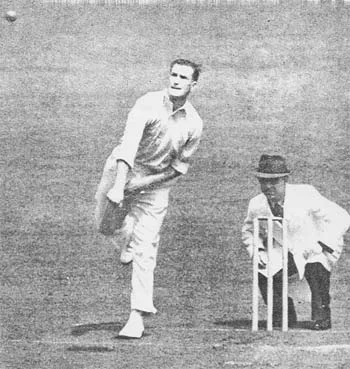
On 31 July 1956, Jim Laker walked into cricket history at Old Trafford. The English off-spinner took 19 wickets for 90 runs across two innings against Australia, a record that stands unbroken nearly 70 years later. His first-innings figures of 9 for 37 remain the best ever recorded in a single Test innings. No bowler has taken more than 10 wickets in a match since.
It is tempting to treat Laker’s achievement as simply the product of genius, a once-in-a-generation bowler meeting a perfect storm of conditions. But that story obscures something more unsettling. The reason no one has broken his record is not that no one has been skilled enough. It is that modern cricket’s structure, philosophy and rules have drifted so far from 1956 that the conditions which permitted his dominance can no longer exist.
The paradox of an unbreakable record
Laker’s 19 wickets remain an outlier even in his own career. Outside the 1956 Ashes series, where he claimed 46 wickets, he never took more than 20 wickets in any other series. The pitch at Old Trafford had been prepared to suit spin bowling. Australia’s batting was unprepared for the conditions. Laker and his partner Tony Lock operated in an era when bowling attacks were less balanced and batsmen saw caution as the path to survival, not a relic of a bygone age.
Today, informed cricket observers suggest the record is effectively unreachable. Not because modern bowlers lack talent, but because the modern game has engineered itself against the very possibility.
Format proliferation: fewer red-ball days
The first structural barrier is time itself. The explosion of T20 leagues and the compression of bilateral cricket schedules mean players have fewer international Test matches per season. Specialist spinners historically positioned to take significant wicket hauls face increased competition for time allocation within their own calendar. A bowler cannot dominate a match that never arrives on the schedule.
This is not a small effect. The busier T20 schedule, combined with international fixtures, has forced teams and players to prioritise franchise cricket over red-ball frequency. When Test series grow shorter and bilateral fixtures fewer, the statistical opportunity for a single bowler to claim 19 wickets in a single match shrinks proportionally.
T20-shaped aggression in Test cricket
Modern batting philosophy has fundamentally changed how players approach Test cricket. Players trained in T20 to read field settings, manipulate gaps and score with urgency now carry that tactical fluency into their long-format game. Captains and coaches no longer treat caution as the only path to victory. The result is a Test batsman who is harder to contain, more willing to attack spin and more mentally equipped to generate scoring opportunities against defensive fields.
In 1956, batsmen prioritised wicket preservation above acceleration. Today, the balance has shifted, with batsmen far more willing to take risks early in their innings. That philosophical inversion makes it radically harder for any spinner to build the suffocating pressure Laker exerted.
Pitches, rules and bowling restrictions
The playing surface itself has changed. Pitches in 1956 were less standardised and more prone to deterioration that favoured bowlers, with irregular bounce and unpredictable turn. Modern cricket grounds are regulated toward greater consistency. Groundskeepers now prepare pitches designed to offer balance between bat and ball.
Simultaneously, the Laws have shifted in batsmen’s favour. Fielding restrictions—such as limits on how many fielders can be placed outside the inner ring during certain overs—constrain a bowler’s ability to set purely defensive fields. The cumulative effect is that a modern bowler, however brilliant, faces structural constraints that their 1950s counterpart never did.
The attack has diversified
Laker operated in an era when bowling attacks were less balanced. He and Tony Lock formed a dominant spin partnership that could bowl the majority of a match’s overs. Modern teams field varied attacks: pace bowlers, spinners of different styles, and all-rounders who bat and bowl. A match is no longer won by a single bowler taking all the wickets. The 20 wickets available for a team to claim are now distributed across four or five specialists.
The closest anyone has come to matching Laker’s dominance in a full match is Anil Kumble, who took 10 wickets in a single innings against Pakistan at Feroz Shah Kotla in 1999. While this remains the modern high point for a single innings performance, no bowler has matched Laker’s two-innings total in a match. This suggests that even in the era immediately before T20’s global ascendancy, the structural environment was already drifting away from Laker’s world.
Why the record endures
Laker’s 19 wickets is thus a record that endures not because it is impossible to reach, but because modern cricket has evolved too far to permit its repetition. The confluence of factors—a sympathetically prepared pitch, less aggressive batting, bowling dominance, and a calendar without competing formats—belonged to mid-20th-century cricket.
In attempting to explain why this record stands, we discover something counterintuitive: the game has not moved beyond Laker through progress alone. It has moved sideways, into a structure where such dominance is no longer available, regardless of talent. The record is unbreakable not despite modern cricket’s sophistication, but because of it.
Sources
- 1956 English cricket season
- Jim Laker | Hall of Fame | ICC
- Jim Laker takes 19 wickets in a match against Aussies
- 'You've got to get them when you can'
- ‘Beach’ dustbowl, stale sandwiches & Marilyn Monroe: The story of Jim Laker’s magical 19-90
- Jim Laker
- Australian cricket team in England in 1956
- 86 – Jim Laker — The Top Order Cricket Podcast