Quick summary (click to reveal)
Summary: Both the Artemis Accords and cricket's ICC governance survive without formal enforcement by combining transparency, reputational cost, and formal representation for weaker parties. However, cricket governance faces greater fragility than space governance because it requires continuous consent from unequal members whose withdrawal would damage the system's legitimacy and commercial viability.
Full article below.
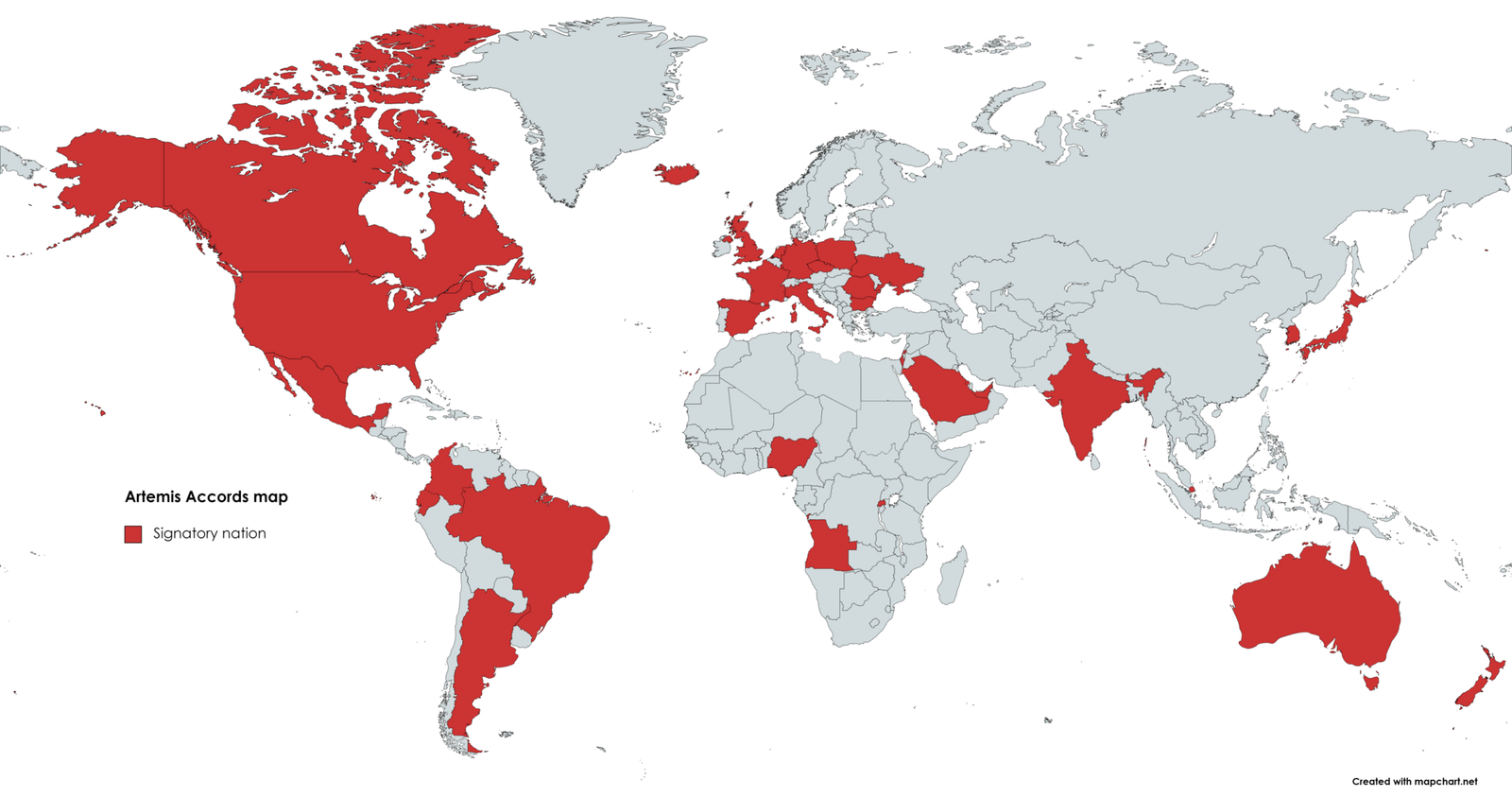
The Artemis Accords, established in 2020 and linked to NASA’s American-led moon program, are not a treaty. They are a set of political principles: peaceful exploration, transparency, interoperability, mutual assistance, and resource-use compliance. Since their inception, nations have signed them voluntarily. Russia and China, both spacefaring superpowers, have not joined. Critically, there is no enforcement mechanism. There are no fines, no suspensions, no formal way to expel participants or compel compliance.
Yet the framework persists. Nations continue joining. This voluntary commitment to a set of rules with no legal force raises a puzzle: why do sovereign nations choose to comply when no one can force them to?
International cricket governance presents a structurally similar puzzle. The ICC, cricket’s global governing body, combines centralized rule-making with distributed authority. The Board of Directors comprises representatives from member nations, and the ICC establishes regulations for international competition formats, scheduling, and player conduct. However, member boards retain significant control over their own domestic operations and fixture selection. The ICC’s power is real but conditional, and constantly contested among its members.
Asymmetry as the foundation
Both frameworks are held together by participants who agree, for now, to follow rules that cannot be enforced against them.
In space exploration, the asymmetry is technological. The United States and its allies possess the rockets, life-support systems, and navigation expertise. Smaller nations contribute funding and scientific capacity but depend on anchor powers’ hardware. In cricket, the asymmetry is commercial. Wealthy cricket nations—particularly India, England, and Australia—generate substantial revenue through domestic leagues and broadcast rights, giving them structural leverage. Smaller cricket nations have neither this financial power nor market influence, yet remain committed to ICC membership and competition structures that provide formal representation.
What prevents either system from collapsing under this weight?
Transparency appears to be essential. The Artemis Accords explicitly require signatories to disclose their space activities and share information about hazardous operations. The ICC publishes its regulations, board decisions, and governance structures. Neither institution operates as a black box. When rules are broken, observers can know. Reputational cost, loss of standing among peers, and exclusion from future cooperation become the primary enforcers.
The second factor is that both preserve formal representation for non-dominant players. The Artemis framework allows participating nations to have a voice in conversations about humanity’s future in space, even if only the wealthiest can actually fund lunar exploration. The ICC’s membership similarly provides a pathway: smaller cricket nations can compete in international fixtures, access ICC development programs, and build infrastructure toward higher competitive status. The system is unequal, but it remains nominally open to participation.
Where fragility emerges
The model faces strain when smaller participants perceive that their formal voice does not translate into meaningful influence. The ICC has implemented governance changes in recent years affecting board composition and voting structures, though the specific outcomes and timelines of these reforms remain contested among member nations. These changes highlight a persistent tension: when dominant institutions adjust decision-making weight without transparent negotiation, the consent that holds the system together becomes strained.
A critical structural difference emerges between the two cases: the Artemis Accords handle dissent through exclusion. Russia and China are not members; their objections do not undermine the framework. The ICC cannot function this way. It requires participation from major cricket nations and sufficient smaller-nation involvement to maintain broadcast rights, bilateral fixtures, and tournament revenue. Cricket governance is therefore more fragile than space governance: it must continuously negotiate consent among unequal partners whose withdrawal would damage the institution’s legitimacy and commercial viability.
Why participation depends on choice
The survival of major cricket formats depends partly on investment decisions by wealthy national boards, who balance cultural value, international prestige, and commercial returns. What the Artemis comparison reveals is how much cricket governance depends on fragile multilateral consent. Broadcasters invest because the ICC coordinates schedules. Players develop because national boards comply with ICC rankings and qualification pathways. Fans watch because the fixture calendar is predictable. All of this rests on member nations agreeing to follow rules that no one can enforce.
The real story is not that protocols make cooperation inevitable. It is that both institutions survive by betting that sovereign actors will continue choosing participation. This bet works only if everyone believes they retain a genuine choice and that transparency ensures they can see when rules are broken. When either condition falters, so does the system.
The enduring tension
Neither the Artemis Accords nor cricket governance has solved the fundamental problem of maintaining order without enforcement. Both institutions demonstrate that voluntary frameworks can persist when built on visible asymmetries, transparent operations, and genuine—if unequal—participation rights. Yet both remain vulnerable to the moment when a major player calculates that the benefits of membership no longer justify the constraints of compliance. Until that moment arrives, soft power and reputation will continue to hold these systems together.
Sources
- THE ARTEMIS ACCORDS: EVOLUTION OR REVOLUTION IN INTERNATIONAL SPACE LAW?
- Artemis Accords | NASA, United States, Outer Space Treaty, Criticism, Summary, Russia, & China | Britannica
- Artemis Accords
- The Artemis Accords: International Cooperation in the Era of Space Exploration
- Artemis Accords: What are they & which countries are involved? | Space
- Artemis Accords – United States Department of State
- The Artemis Accords Explained | New Space Economy
- Artemis Accords Explained: The Rules Guiding Humanity’s Return to the Moon — 2LOUDMag