Quick summary (click to reveal)
Summary: England lost to Australia by 7 runs at The Oval on 29 August 1882, their first defeat on home soil. A satirical obituary in The Sporting Times on 2 September 1882 mocked the loss by declaring English cricket dead and its ashes bound for Australia. That obituary spawned the name and concept of The Ashes rivalry, formalized a year later when England's captain received a small urn in Australia.
Full article below.
On the afternoon of 29 August 1882, at Kennington Oval in London, the English cricket establishment suffered an indignity that would redefine international cricket for the next 142 years: they lost to Australia on home soil for the first time. The defeat was narrow—Australia won by just 7 runs—but the wound was deep. England, the birthplace and master of the game, had been beaten at their own ground by a colonial outpost. Within four days, an English journalist named Reginald Shirley Brooks would turn that humiliation into immortality.
What began as satire became sport’s greatest rivalry. The Sporting Times published Brooks’s mock obituary on 2 September 1882. It read: “In affectionate remembrance of English Cricket, which died at the oval on 29th August, 1882. Deeply lamented by a large circle of sorrowing friends and acquaintances. R.I.P. N.B. — The body will be cremated and the ashes taken to Australia.” That single joke, published in the aftermath of a shocking loss, named a rivalry that still commands global attention. It is The Ashes.
How England Lost What Should Have Been Easy
Australia arrived at The Oval needing everything to go right. They had scored only 63 in their first innings. England, batting second, needed just 85 to win. The mathematics favoured the home side overwhelmingly.
But cricket, as it often does, defied arithmetic. England reached 51 for 2 wickets—needing only 34 more runs—and appeared certain to win. Then W.G. Grace, the most celebrated batsman in England, was dismissed for 32. What followed was systematic destruction. The Australian fast bowler Fred Spofforth, operating at lethal pace, dismantled the rest of the English batting order with figures of seven for 44. England limped to 77 all out, falling 8 runs short of victory.
The crowd at The Oval fell briefly silent at the final dismissal. Then they surged onto the field, not in mourning but in recognition of something extraordinary: they had witnessed the upset that would reshape cricket history. The Australian players—Spofforth and Boyle especially—were chaired to the pavilion by cheering spectators.
A Joke Becomes a Crown
The Sporting Times obituary was meant to sting. It did. But it also did something unexpected: it crystallised English cricket’s response. Rather than sulk, the English cricket authorities seized on the rhetoric of restoration. When England’s captain, Ivo Bligh, led a tour of Australia in the 1882–83 season with the explicit aim of recovering “those Ashes,” everyone understood the reference. The satirical funeral notice had become a battle standard.
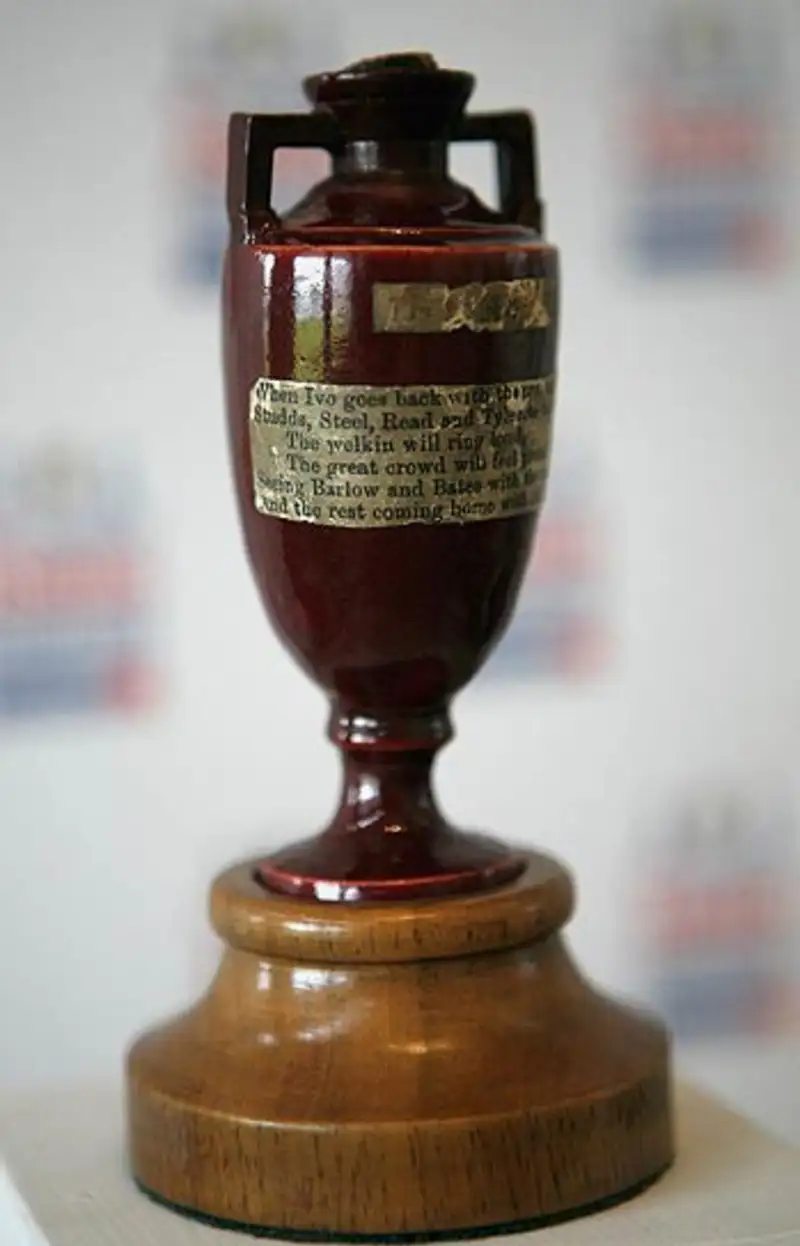
After England won the third match of that tour, a group of Melbourne women, including Florence Morphy (who would later marry Bligh), presented him with a small terracotta urn believed to contain the ashes of a burnt bail. This was the physical embodiment of Brooks’s joke: the ashes of English cricket, literally in a vessel, headed to Australia by England’s defeated captain.
When Ivo Bligh died in 1927, Florence donated the urn to the Marylebone Cricket Club at Lord’s, where it remains. The urn itself is now insured for millions and sits in a locked case. No one is allowed to touch it. Yet the rivalry it symbolises is touched every summer when England and Australia meet. It is played for with the intensity reserved for wars that are not wars.
Why This Matters
The 1882 Oval Test was not technically a Test match at the time; Test cricket did not officially exist then. Yet it has been retrospectively recognised as a Test by cricket historians. The match was a first-class encounter between two national teams, and that was enough to matter enormously.
What makes this moment unique is not merely that England lost. It is that a sportswriter’s grief-stricken joke became the naming act of a rivalry that would dominate world cricket for 142 years and counting. The obituary did not describe an existing rivalry; it created one. It transformed a single defeat into a narrative of redemption and national pride that reached across oceans and defined how two nations would compete against each other.
Spofforth’s bowling that day changed cricket. Brooks’s pen changed how cricket was remembered.
Sources
- TEST: England v Australia at The Oval, 28-29 Aug 1882
- ENG vs AUS Cricket Scorecard, Only Test at London, August 28 – 29, 1882
- Only Test match, England v Australia 1882, The Oval – Almanack report
- Scorecard – 1882 England v Australia – 1st Test – 28/08/1882 – Kennington Oval, London – Test No. #9
- 150 Years of Test Cricket History | 150th Anniversary Test Match
- International cricket in 1882
- English cricket team in Australia in 1882%E2%80%9383
- Australian cricket team in England in 1882